A Threatened Louisiana Icon
By Development Director, Kayla Green (former Louisiana resident)
October 2026 Update: Plaquemine Point's Old-Growth Forest Remains Threatened
Learn more and see photographs of the forest: https://savethepoint.info/
The proposed Mississippi River Bridge South project is moving forward, and Route E-11-IV remains one of three alternatives under consideration. If selected, this route would cut through Plaquemine Point's old-growth cypress forest and surrounding community in Iberville Parish, Louisiana.
Route E-11-IV remains under consideration despite concerns about the accuracy of data used in the Louisiana Department of Transportation and Development's (DOTD) 2022 evaluation. Local residents have challenged findings that underestimated impacts to wetlands, pipeline relocation costs, and public opposition while overstating projected traffic benefits.
The Draft Environmental Assessment (EA) is expected to identify a preferred route soon, with DOTD public hearings to follow. Now is an important time to make your voice heard. The forest's landowners and surrounding community continue to oppose Route E-11-IV and want to see this centuries-old forest protected for future generations.
How You Can Help
Write to the Decision-Makers
While we await the Draft Environmental Assessment and public hearing dates, you can make your voice heard by emailing the decision-makers listed below or submitting a comment through the Mississippi River Bridge South online contact form.
When writing, please include the following project information:
State Project No.: H.013284
Federal Aid No.: H013284
Project Name: MRB South GBR: LA 1 to LA 30Opposed to Alternative E-11-IV (OPPOSE)
—
Share your concerns about Route E-11-IV and its potential impacts on Plaquemine Point's old-growth forest and historic community. Your message does not need to be long or technical. A few thoughtful sentences in your own words can make a difference.
For more information about the project and how to get involved, visit Save the Point.
See below for where to send your comment
-
Federal Highway Administration — Louisiana Division (Lead Agency)
Melinda Roberson
Division Administrator
Federal Highway Administration - Louisiana Division
5304 Flanders Drive, Suite A
Baton Rouge, LA 70808
melinda.roberson@dot.govLarry Breland
Environmental Specialist
Federal Highway Administration
5304 Flanders Drive, Suite A
Baton Rouge, LA 70808
larry.breland@dot.govFederal Highway Administration — National
Ms. Emily Biondi, Director
Office of Project Development and Environmental Review
Federal Highway Administration
Southeast Federal Center Building
1200 New Jersey Ave., SE
Washington, DC 20590-9898
emily.biondi@dot.govMs. Damaris Santiago, Director
Office of Project Development and Environmental Review
Federal Highway Administration
Southeast Federal Center Building
1200 New Jersey Ave. S.E.
Washington, DC 20590-9898
Damaris.Santiago@dot.govMr. Gary A Jensen, Director
Office of Natural Environment
Federal Highway Administration
Southeast Federal Center Building
1200 New Jersey Ave. S.E.
Washington, DC 20590-9898
gary.jensen@dot.govMichelle Hilary, Technical Director
Environment and Air Quality Team
Federal Highway Administration
Southeast Federal Center Building
1200 New Jersey Ave. S.E.
Washington, DC 20590-9898
michelle.hilary@dot.govLouisiana Department of Transportation and Development (Responsible Agency)
Secretary Glenn Ledet
Louisiana Department of Transportation and Development
1201 Capitol Access Road
Baton Rouge, LA 70802
glenn.ledet@la.govChristina Brignac, Mississippi River Bridge Project Manager
Louisiana Department of Transportation and Development
1201 Capitol Access Road
Baton Rouge, LA 70802
Christina.Brignac@la.govUnited States Department of Transportation
Rebecca Yedlin
Environmental Policy Analyst / Federal Preservation Officer
Infrastructure Permitting Improvement Center
United States Department of Transportation
Washington, DC
Rebecca.Yedlin@dot.govLegislators
Representative Chasity Martinez
57835 Plaquemine Street
Plaquemine, LA 70764
hse060@legis.la.govSenator Ed Price
2115 S. Burnside Ave., Suite B
Gonzales, LA 70737
pricee@legis.la.govn text goes here
Next Public Meeting
Monday, December 14, 2026
2:00 PM CST
Louisiana State Capitol Building
900 N. 3rd Street
Baton Rouge, LA 70802
Parking is available on Spanish Town Road, south of the Capitol Park, or on the River Road lot. The meeting will be held on the ground floor of the Capitol in Senate Committee Room E or F.
Public Meeting Recordings
September 28, 2026 | June 29, 2026 | March 30, 2026
December 15, 2025 | September 29, 2025 | June 30, 2025 | March 31, 2025
December 16, 2024 | September 30, 2024 | June 24, 2024 | March 25, 2024
December 11, 2023 | June 26, 2023 | March 27, 2023
December 12, 2022 | September 26, 2022 | May 27, 2022 | March 28, 2022
December 13, 2021 | September 27, 2021 | June 28, 2021 | March 29, 2021
December 14, 2020 | September 28, 2020 | June 29, 2020 | January 27, 2020
October 21, 2019 | July 29, 2019 | June 17, 2019 | February 5, 2019
What’s At Stake
The Louisiana Department of Transportation and Development (LA DOTD) is beginning its plans to create a new Mississippi River South Bridge in Iberville Parish. The bridge would connect Louisiana Highway 1 on the west side of the river to Highway 30 in east Iberville.

The three proposed routes (marked in blue) for the new Mississippi River South Bridge. Route E-11-IV for Project MRB South GBR: LA 1 to LA 30 runs through the A.E. LeBlanc Forest property (marked in black) and would remove several centuries-old cypress trees. Construction would also permanently alter the thriving intact forest ecosystem.
Consultants hired by the LA DOTD originally had a list of 32 possible locations. The seven-member commission narrowed the list to three locations in May of 2022. One of the three possible locations would tear through one of the oldest and most beloved intact cypress forests in the area (link), called the A. E. LeBlanc Old-Growth Forest.
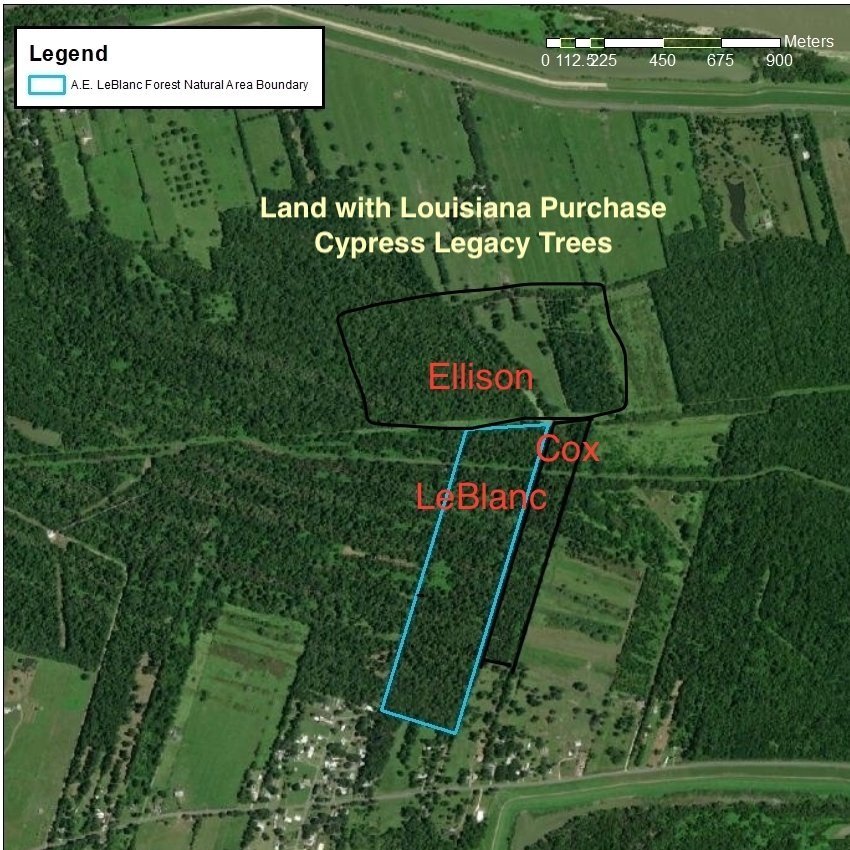
A. E. LeBlanc Old-Growth Forest Boundary

Cliff and Laura Comeaux, part owners of the A. E. LeBlanc Old-Growth Forest
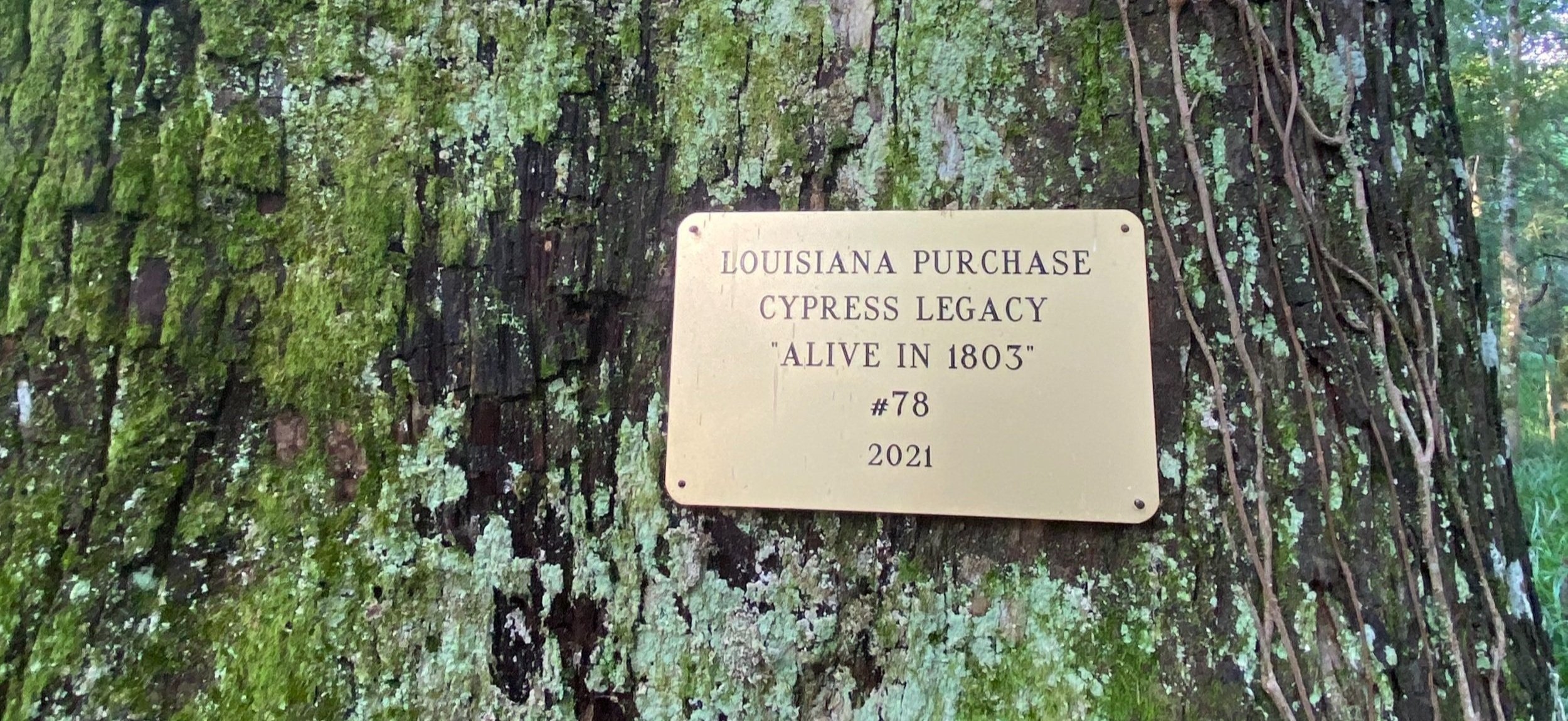
The A. E. LeBlanc Old-Growth Forest is located in Sunshine, Louisiana (Iberville Parish). It has been in the Comeaux family for over 200 years and sixteen descendants of early Acadian settlers currently own the forest including Laura and Cliff Comeaux (see photo above). The forest is a member of the Old-Growth Forest Network’s Private Forest Registry and a registered Louisiana Natural Area as part of Louisiana Department of Wildlife and Fisheries’ Wildlife Diversity Program. There are large cypress specimens in the 60-acre forest, with conservative age estimates ranging from 90 to 360 years old. Many of the oldest specimens are over 220 years old, qualifying them as “Louisiana Purchase Cypress Legacy” trees.
Despite receiving these national and state recognitions, the A. E. LeBlanc Old-Growth Forest is under threat, with more than fifty centuries-old trees to be destroyed, if chosen as the final location for the new bridge.

Photo of A. E. LeBlanc Old-Growth Forest
Below is a letter written to the Louisiana Department of Transportation and Development in opposition to the proposed route that would threaten the survival of this centuries-old family forest.
November 2023
Mr. Robert Lott
Assistant Environmental Engineer Administrator
Louisiana DOTD, Office of Engineering Environmental Section
P.O. Box 94245
Baton Rouge, LA 70804
Dear Mr. Lott,
This letter is in reference to the A. E. LeBlanc Forest Natural Area that is part of Iberville Parish Parcel 0400538300. I am in opposition to route E-11-IV for Project MRB South GBR: LA 1 to LA 30.
Here is why.
In June 2023, I had the opportunity to visit the 60-acre A. E. LeBlanc Old-Growth Forest in Sunshine, LA and see first-hand the awe-inspiring cathedral ceilings of bald cypresses towering over a rare and incredibly diverse ecosystem that has remained undisturbed by humans for centuries. It is unlike anything I have ever seen in southeast Louisiana, and it is why I am writing this letter in opposition to the proposed route E11-IV for Project MRB South GBR: LA 1 to LA 30.

On an individual basis, old-growth cypress is not hard to find in Louisiana, but entire intact forests of the ancient trees are extremely rare in the state. (Photo of A. E. LeBlanc Old-Growth Forest)
As you know, the bald cypress is a Louisiana icon and our official state tree. It is the tree that built New Orleans, erected Baton Rouge, and turned Louisiana into the prosperous developed state that 4.6 million people now proudly call home. It is also the oldest known wetland tree species on the planet and can regularly reach up to 600 years in age. Because of Louisiana’s vast delta network, bald cypress forests thrive in almost every natural environment this state has to offer. Our state is called the “Sportsman’s Paradise” and there is no other tree more important to our local wildlife than the bald cypress, especially older ones. Black bears, woodpeckers, warblers, wood ducks, and bats all nest in the hollows of large cypresses. The flat tops of older cypresses make exceptional nesting sites for our national bird, the bald eagle. I cannot think of a better symbol to represent the spirit of Louisiana’s inhabitants than the mighty bald cypress.

A. E. LeBlanc Old-Growth Forest
Only a hundred years ago Louisiana had the largest and oldest intact cypress forest in the entire country. But a combination of a growing population, demand for durable and superior building materials, and lack of foresight to leave at least some of our inherited old-growth cypress forests standing for future generations has left only a handful of them around today. For a tree that is considered the embodiment of Louisiana’s natural beauty, it would be a tragedy if we did not preserve one of the few remaining intact old-growth cypress forests in the state such as the A.E LeBlanc forest.
Other states like South Carolina and North Carolina worked to preserve these treasures. For example, South Carolina is home to the Congaree National Park which is dedicated to its vast old-growth bald cypress forests. Similarly, North Carolina’s privately owned Black River Preserve protects the oldest bald cypresses in the world including some that are over 2,600 years old.

Old-Growth Forest Network Founder, Dr. Joan Maloof, and Executive Director, Dr. Sarah Adloo, at Congaree National Park in South Carolina
Instead, Louisiana is proposing to destroy a 60-acre extremely rare 300+ year old bald cypress forest that has been carefully stewarded by Louisiana families for generations. At the same time, Louisiana is working hard to reestablish its bald cypress populations by spending nearly $17 million planting saplings for coastal forest restoration. Why would we both spend money to plant bald cypresses while simultaneously cutting cypress forests down?
This forest gives our state the opportunity to do what our ancestors could not. Let’s make Louisiana a haven for old-growth bald cypresses once more on both public and private property.

Photo of A.E. LeBlanc Forest
I urge you and others in your office to visit the A. E. LeBlanc Old-Growth Forest. I encourage you to see, feel, hear, and smell the thriving old-growth bald cypress ecosystem that still has centuries left to grow. This forest has stood for over 300 years and with your help it can stand for 300 more.
We have a duty to our descendants to leave this earth better than we found it. Let’s start by keeping the A. E. LeBlanc Old-Growth Forest standing. Future Louisianians will be proud you did.
Sincerely,
Kayla Green
Development Director, Old-Growth Forest Network
Louisiana Resident (2009-2021)
Loyola University New Orleans (Class of 2013)
Great Granddaughter of Dr. Martin Owen Miller (1894-1975), a ninth generation Louisianian
Additional resources on the Mississippi River Bridge project and history of old-growth cypress forests in Louisiana:
OGFN Letter to the Editor in The Advocate newspaper: July 7th, 2025
The Advocate Letter to the Editor: July 17th, 2025 from Angelle Bradford Rosenberg, Chapter Chair, Sierra Club Delta Chapter.
(Video) The last public meeting was on March 31st, 2025 . The recordings can be found here .
(Video) Capital Area Road and Bridge District Meeting on September 25, 2023: https://ibervilleparish.com/parish-council/videos/ (enter “Capital Area Road” into the search bar and the video will pop up)
The Cultural Landscape Foundation: Plaquemine Point Faces Imminent Threat
Top Ranked Mississippi River Bridge Location Threatens Old Growth Cypress in Iberville Parish