
Resources for Forest Managers
From the redwoods to the northwoods, the Old-Growth Forest Network partners with forest managers at all levels of public, private, and non-profit organizations and agencies to showcase and provide education and interpretation on the diverse values of protected old-growth forests around the country. While the scope of our mission is nationally focused, OGFN recognized forests are nominated by a system of volunteers working at the county-level. Once accepted into the Network, these forests are celebrated with the local community of stewards and stakeholders and showcased nationwide.
As the Network expands, we seek to work cooperatively with forest managers, create resources to aid stewardship and leverage the Network for better outcomes for old-growth forests. Below we’ve compiled the most frequently asked questions from forest managers about OGFN and our processes.
We look forward to partnering with you.
Feel free to scroll through the entire list of questions and answers, or skip to the question(s) that interest you the most:
What benefits does joining the Network provide to forest managers?
How does the Old-Growth Forest Network define old-growth?
Which forest types can be recognized in the Network?
Is the Network limited to Primary or “Never Logged” Forests?
Is there a minimum or maximum acreage to be considered for the Network?
Are there resources to help me manage my forest?
What types of forest management are compatible with OGFN recognition?
Are ecological restoration projects compatible with OGFN recognition?
What is the process for being nominated and recognized in the Network?
What benefits does joining the Network provide to forest managers?
Forest recognition through the Network provides opportunities to interpret and showcase your forest stewardship, increases engagement with forest stakeholders, and provides assurances to the public that treasured forests are being well stewarded.
Each time we step into the forest with our peers, we create the space for dialogue, shared appreciation of biodiversity and our natural heritage, and deepen our collective understanding of issues impacting forests.
OGFN hikes can help build local support for the forest by recognizing it as a treasured place to experience nature, celebrating the work of local volunteers, instilling knowledge of local native species and Leave No Trace principals, and sharing the challenges our current and future forests face.
OGFN also supports forest managers by providing access to a network of people with expertise and connections for collaboration, as well as continuing education opportunities for forest managers through programming like webinars, talks, gatherings, and the Northeast Old-Growth Conference. The benefits of being a part of the Old-Growth Forest Network continue long after we celebrate a forest’s inclusion.
How does the Old-Growth Forest Network define old-growth?
The Network does not rely on any specific definition to define old-growth, and no widely accepted definition exists. Old-growth is a human construct that seeks to describe a stage along a continuum in the cyclical development of forest ecosystems where age-related attributes and processes evolve and converge within a discrete area of natural land. The diverse characteristics of old-growth are expressed based on a variety of interrelated factors, not limited to tree species morphology, longevity, shade tolerance, site conditions, disturbance regimes, human influences and uses, species interactions, and ecological processes. (See illustrated examples of Moist and Dry old-growth features in our Resources)
Many organizations and agencies have formulated criteria for specific forest types, such as a number of trees per acre of a certain size and age, which they use to determine whether or not a forest will be categorized as old-growth under their specifications (See examples from the USFS in Appendix 1 of this document). While the Network often accepts forests categorized or designated by other organizations as old-growth, we also include forests that have old-growth characteristics or are developing old-growth characteristics but may not fall into specific classifications or designations.
Which forest types can be recognized in the Network?
Old-growth can be expressed in many forms, including within dwarf forests, or even open canopy, short-statured forests like pinyon-juniper woodlands, which take centuries to develop and last for centuries into the future in an old-growth stage. Fast-growing, short-lived trees like aspen reach a more transient old-growth stage that lasts on the order of decades, providing a more ephemeral but biologically valuable resource. Other forest types like oak-hickory or ponderosa pine require frequent low intensity fire to maintain and perpetuate the old-growth stage, which can last for centuries. The Network seeks to identify, showcase, and educate on the diverse values and characteristics of all old-growth forests.
Not all forests within the Old-Growth Forest Network are old-growth or late-successional at present. Typically, OGFN seeks out the oldest forests within a county to be included in the Network, and at times, those may be maturing second-growth forests that will age into old-growth given time. These future old-growth forests are an equally important part of the Network.
Is the Network limited to Primary or “Never Logged” Forests?
Primary or “never logged” forests are increasingly rare and have unique ecological and social values. While highly regarded by OGFN, the Network does not limit the concept of old-growth to primary forests alone. Past human activities and their ecological impacts on forests are highly variable. While forests of the past can not be replicated, with adequate protections and careful stewardship, many once logged forests termed ‘future old-growth’ may be primed to cycle into old-growth once again.
Is there a minimum or maximum acreage to be considered for the Network?
A minimum of 10 acres of forest is required. There is no maximum number of acres. The Network includes many smaller protected forests and some very large areas of protected forest like National Parks and Wilderness Areas. The area recognized by the Network can extend to entire parks and preserves or include smaller protected areas within larger forests managed for multiple uses, such as special designated areas within a State Forest or National Forest. The area recognized in the Network often includes compatible forested areas in addition to the old-growth, which helps to provide a buffer and allows for eventual potential expansion of the old-growth area.
Are there resources to help me manage my forest?
We created a template that can be used to assess and outline goals and describe recommended activities for stands that have been identified by the landowner and plan writer as old-growth or future old-growth on public or private lands. This template is compatible with a variety of approaches from ‘hands-off’ management that openly accepts future changes, to those that seek to actively restore conditions, or those that seek to guide anticipated transformational changes to the forest with time. Note that this template should generally be used within a broader forest management plan for the overall ownership.
Planning for Future Old-Growth - A Stand-Level Template for the Forest Management Plan
What types of forest management are compatible with OGFN recognition?
OGFN recognition is most compatible with management approaches that protect and perpetuate old-growth forest features, maintain the primary influence of natural forces, processes, and ecosystem function, and avoid interventions that disrupt continuity or impact the perceived naturalness of the forest.
OGFN maintains the following Forest Management Standard to which all forests are held: Forests recognized in the Old-Growth Forest Network shall be open for public visitation, composed of primarily native species, including stands with trees that are relatively old and large for the geographic location, site conditions, and species, harbored within a delineated area of natural land managed to allow for a continuous heritage of natural disturbance and reproduction, reserved from commercial extraction including timber production, and protected from logging practices that disrupt ecological continuity and complexity. To safeguard refugia and natural processes, interventions are limited to situations of visitor safety and trail maintenance, to suppress non-native species, for traditional and cultural indigenous uses, or to restore ecosystem functioning that has been disrupted by past or ongoing human activities as outlined in a resource plan, consistent with the above, maintaining old-growth characteristics and the recreational experience to the greatest extent possible.
Are ecological restoration projects compatible with OGFN recognition?
OGFN recognition should generally extend to areas in the maintenance phase of ecological restoration. In areas where major restoration projects have been recently undertaken or are planned, recognition should follow a visual impact recovery period (i.e. initial recovery of native ground-layer flora, natural staining of cut stump faces, decomposition initiated in felled logs, brush piles, etc.). Where projects are expected to have continuous or repetitive, widespread, long-lasting, mechanically-induced visual impacts, OGFN recognition may not be compatible.
It is recommended that forests under restoration include delineated core areas of high-quality forests where mechanized equipment disturbances are prohibited or strictly limited to situations described above in the forest management standard. Perimeter areas where management activities may include thinning (with or without the removal of commercial products) and creation of fuel breaks should be excluded from the recognized area.
What is the process for being nominated and recognized in the Network?
OGFN receives nominations from the public through our online portal. Once we receive a nomination, OGFN staff work with volunteer county coordinators, who help explore forests locally, to collect photos, gather more information and compare the site to other options in the county of interest. If needed, OGFN staff reach out to forest managers to seek information about how the forest is protected and stewarded.
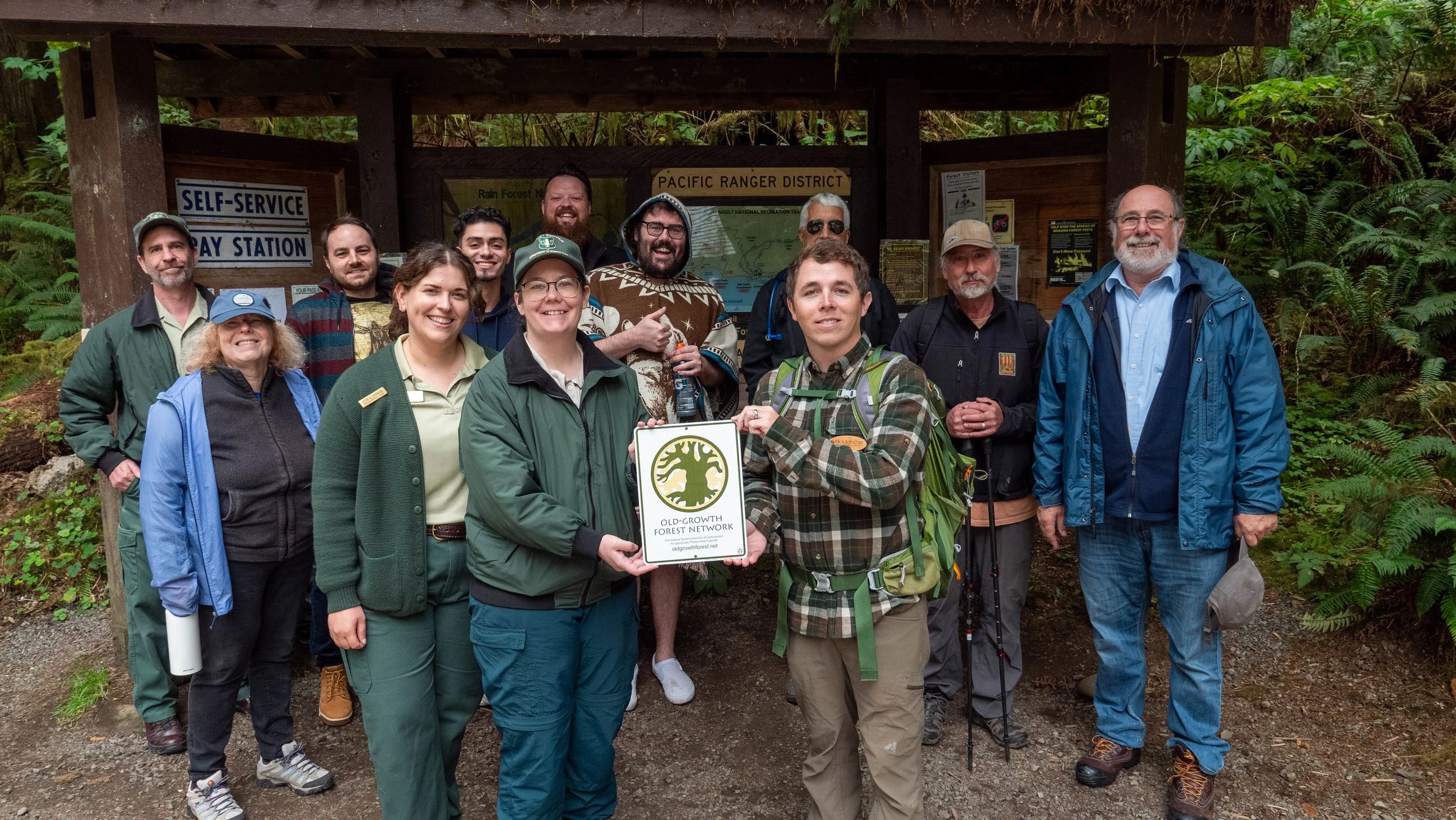
If the forest is compatible with the Network, OGFN will seek to coordinate with the forest manager to plan an optional celebratory event to showcase the forest. At this event, OGFN provides a 9”x12” aluminum sign to be displayed at the discretion of the forest manager at the trailhead or other suitable location, along with a 4”4” trail sign which can be attached to a wayfinding post. OGFN works with the forest manager, volunteers and local groups to provide an interpretive hike led by a local expert which is advertised through local media channels along with an announcement of the recognition. A profile which highlights the forest and provides access and trail information to the public is then added to our website. OGFN will work with forest managers to make sure this website profile stays up to date.
How can I get additional signs for my forest?
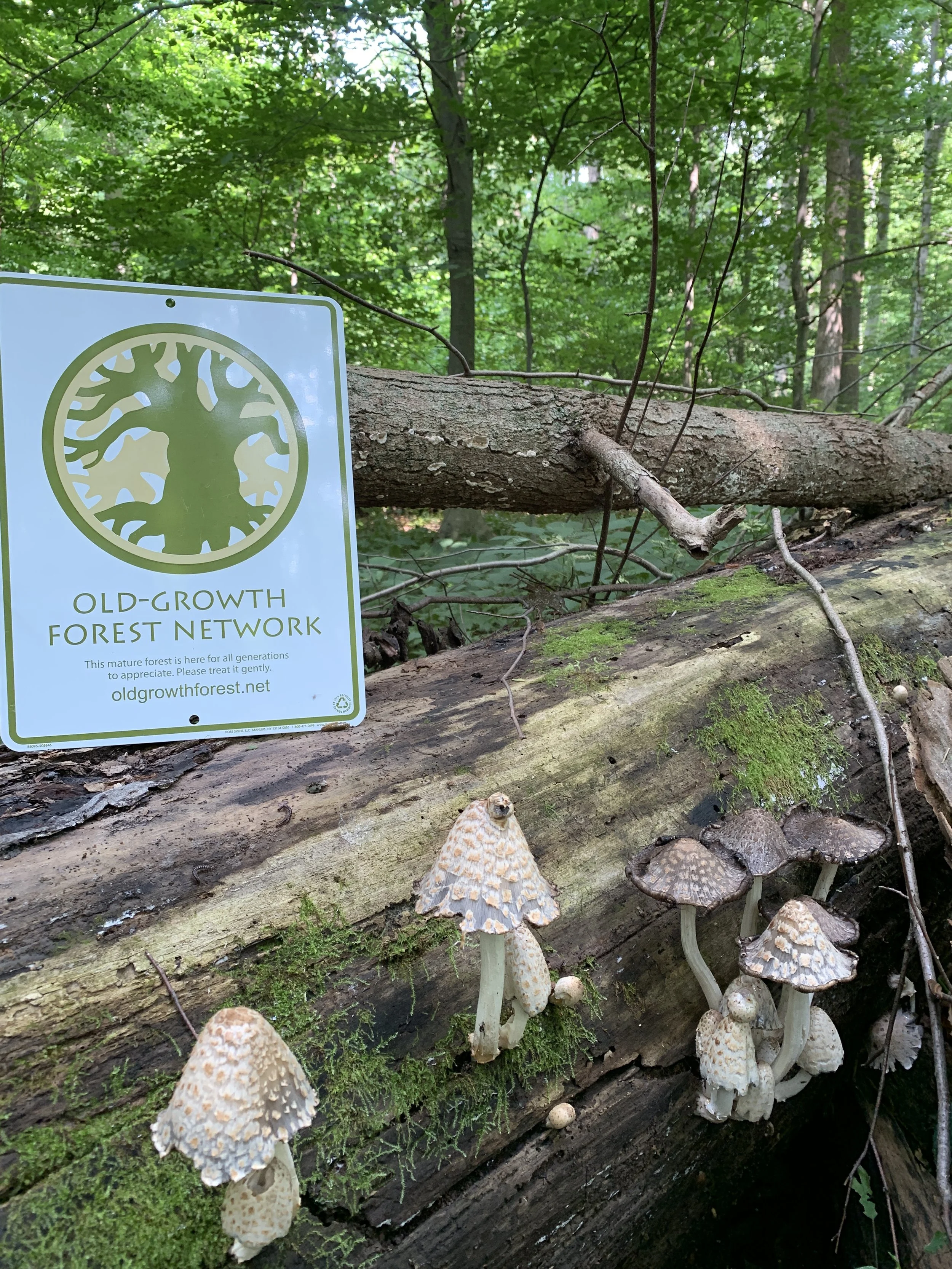
Damaged or lost signs will be replaced at no cost. Please reach out to info@oldgrowthforest.net to request more signs.
Additional signs must be purchased to cover materials and shipping.